How Campus Culture Shapes Student Life in Pune
The first thing most students remember about their early days in Pune is rarely a lecture hall or a syllabus. It is usually something else entirely. A crowded college corridor buzzing with club sign ups, a badly designed poster announcing a fest, seniors arguing over sound checks, or a random workshop happening in a classroom at 7 pm when the day was technically supposed to be over.
Pune does not introduce itself to students through academics alone. It does so through its campuses, noisy, layered, sometimes chaotic spaces where learning spills far beyond the timetable. Over time, these spaces begin shaping how students speak, organise, collaborate, take risks, and imagine futures that are not strictly tied to grades.
Campus culture here is not ornamental. It is functional. It quietly trains students for life outside the classroom, often without them realising it.
Campuses as Social Laboratories, Not Just Institutions
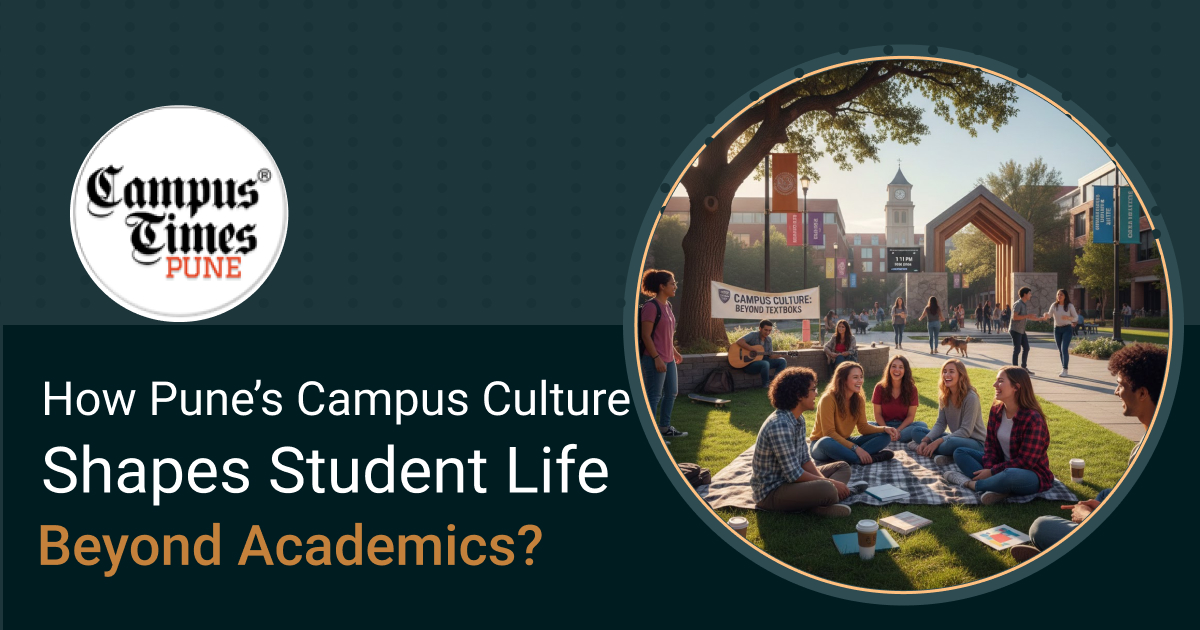
Walk through any major college campus in Pune on a weekday evening and you will notice how little of student life revolves around formal instruction at that hour. Classrooms are empty, but auditoriums, staircases, lawns, and canteens are not.
Campuses operate like social laboratories. Students test ideas, identities, leadership styles, and failures in relatively low stake environments. Organising a debate competition or managing registrations for a technical fest teaches conflict resolution faster than any theory module. Running a student led workshop exposes gaps in communication skills that no internal assessment ever flags.
This culture of learning by doing is deeply embedded. Most campuses actively encourage students to experiment, sometimes officially, sometimes informally, and the sheer density of student initiatives creates a feedback loop. You see something working elsewhere on campus, you try your own version, and suddenly learning feels iterative instead of linear.
Fests as Training Grounds for Real World Skills
Annual cultural and technical festivals are often dismissed as distractions, but in Pune, they function more like compressed internships. Months before the main event, students are already negotiating sponsorships, managing budgets, coordinating vendors, and dealing with unpredictable logistics.
What is striking is how early this exposure begins. First year students are not just spectators. They are volunteers, design leads, social media coordinators, or logistics runners. They learn the cost of poor planning, the pressure of deadlines, and the diplomacy required to work with diverse teams, all before most of them have written a single professional email outside college.
By the time these students graduate, event management is not an abstract skill. It is something they have lived through repeatedly, learning from mistakes that no classroom simulation could replicate.
Clubs and Societies as Long Term Identity Builders
Unlike one off events, student clubs shape campus culture in quieter, longer arcs. Over time, clubs become spaces where students develop consistency. Showing up every week, mentoring juniors, sustaining momentum even when attendance drops.
In Pune, clubs are rarely siloed. A photography club collaborates with a theatre group. A coding society partners with a social initiative for a hackathon. These overlaps encourage interdisciplinary thinking early on, blurring the rigid boundaries between arts, tech, and management that formal curricula often enforce.
For many students, clubs become anchors. They provide belonging in a city where most students live away from home, navigating independence for the first time. That sense of community, built through shared projects rather than shared classrooms, often lasts far beyond graduation.
Exposure Through Workshops, Talks, and Student Led Events
One defining feature of Pune’s campus ecosystem is the frequency of student organised workshops and talks. Unlike centrally planned academic seminars, these events are usually driven by curiosity. A new tool, a trending field, or an emerging career path.
Because students themselves identify the gaps, the topics feel timely. A workshop on podcasting, UX design, mental health advocacy, or startup finance often emerges months before these subjects appear in formal syllabi.
Equally important is who conducts these sessions. Alumni, local professionals, founders, artists, and researchers regularly find their way into classrooms through informal networks. Students learn how to reach out, pitch ideas, and host conversations, skills that quietly prepare them for professional environments.
Peer Learning as an Unofficial Curriculum
In many Pune campuses, the most influential teachers are often peers. Seniors who have cracked competitive exams, classmates who have interned at niche firms, or juniors who bring unexpected skills to the table.
Peer to peer learning thrives in hostel rooms, libraries, cafes near campus, and even during bus rides. Notes are shared, interview experiences dissected, and failures discussed openly. This informal knowledge exchange creates a parallel curriculum that is adaptive, practical, and rooted in lived experience.
Leadership Without Titles
Not all leadership on Pune campuses comes with official designations. Some of the most influential students are those who consistently show up, mediating conflicts, keeping teams motivated, or stepping in when systems fail.
This form of leadership is situational rather than positional. It emerges during crises and teaches students how to influence without authority and adapt without formal training.
Navigating Diversity and Difference
Pune’s campuses bring together students from across Maharashtra, India, and increasingly international backgrounds. Students learn to negotiate language barriers, cultural assumptions, and differing expectations through daily collaboration.
Failure as a Visible, Accepted Outcome
Because experimentation is encouraged, failure is normalised. Students learn resilience through lived disappointment and recovery rather than motivational talks.
The Quiet Confidence Students Carry Forward
By the time students leave Pune, many carry confidence built from managing people, presenting ideas, solving problems without instructions, and building communities from scratch.
In Pune, student life beyond academics is not an add on. It is the ecosystem in which students learn how to exist professionally, socially, and personally.